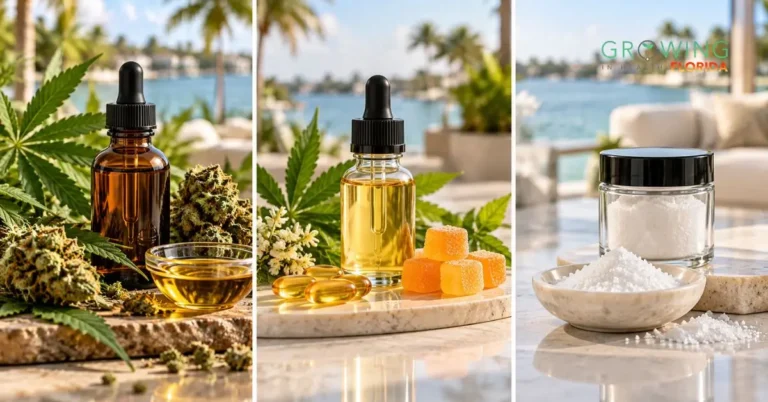

Cannabinoids explained in one line: they’re the active compounds in hemp that talk to a signaling network inside your body. The National Cancer Institute reports that over 100 cannabinoids have been found in cannabis, yet only a handful reach your product label. This glossary from Growing In Health Florida breaks each one down so you can read that label like a pro.
TL;DR

Cannabinoids work by binding to docking points your body already built. Scientists call this network the endocannabinoid system, and it helps regulate sleep, mood, appetite and pain.
Two receptors matter most. CB1 sits mostly in your brain and nerves. CB2 lives in your immune system and body tissue.
Your body makes its own versions too, called anandamide and 2-AG. Plant molecules fit those same locks, which explains why hemp does anything at all.
The plant stores these compounds in trichomes, the sticky resin glands on the flower. Staff at Growing In Health Florida walk Naples shoppers through this every day, and you can shop our CBD range in Naples once you know what you’re after.
Three types of cannabinoids exist. Phytocannabinoids come from the plant. Endocannabinoids come from your body. Synthetic cannabinoids come from a lab.
Everything on the hemp shelf at Growing In Health Florida in Collier County falls into the first group. Here’s how the six main ones compare.
| Cannabinoid | Say it | Full name | Gets you high? | Typical use |
| THC | tee-aych-see | Delta-9-tetrahydrocannabinol | Yes | Discomfort, appetite, rest |
| CBD | see-bee-dee | Cannabidiol | No | Calm, recovery, daily use |
| CBN | see-bee-en | Cannabinol | Mildly | Nighttime routines |
| CBG | see-bee-gee | Cannabigerol | No | Daytime focus, gut support |
| CBC | see-bee-see | Cannabichromene | No | Full-spectrum blends |
| THCA | tee-aych-see-ay | Tetrahydrocannabinolic acid | Only when heated | Raw hemp products |
THC and CBD are the two molecules that dominate every hemp shelf in Naples. Together they make up the bulk of what a lab report shows.
THC binds straight to your CB1 receptor. That direct fit is what creates the high, plus the appetite bump people notice.
CBD takes a different route. It touches serotonin receptors and slows the breakdown of your own anandamide, so you get an effect without intoxication.
One practical warning: CBD changes how your liver handles certain prescriptions. Talk to your doctor first if you take daily medication. The tincture counter at Growing In Health Florida in Naples carries beginner strengths for exactly this reason.
Minor cannabinoids appear in tiny amounts, usually under 1% of the plant. Growers concentrate them on purpose, which is why Growing In Health Florida now stocks single-cannabinoid tinctures at its Naples hemp store.
CBN forms when THC ages. Light, heat and time break delta-9 down into cannabinol, and that’s why old flower feels heavier. Sleep research on CBN remains early. Degraded terpenes drive part of the weight people feel.
CBG earns the nickname “mother cannabinoid.” The plant converts its acid form, CBGA, into THCA, CBDA and CBCA. Mature plants keep almost none in reserve. Shoppers weighing cbd vs cbg usually land on CBG for daytime and CBD for evening.
CBC ranks third by volume yet rarely headlines a product. It pulls its weight inside full-spectrum blends rather than standing alone.
Naples shoppers see THCA on raw hemp labels more than any other acid form. THCA is unheated THC, and in that state it won’t get anyone high, because the molecule’s shape doesn’t fit your CB1 receptor.
Add heat and everything shifts. Smoking, vaping or baking strips a carbon dioxide group off the molecule. Chemists call that reaction decarboxylation. What’s left behind is active delta-9.
Florida regulators account for this. FDACS applies a total delta-9 standard, calculated as delta-9 plus 0.877 times THCA. That 0.877 figure represents the weight lost during conversion.
So a raw flower sold near Golden Gate can test low on delta-9 and still land above the limit once the math runs. Ask the hemp team at Growing In Health Florida for the batch report before you buy.
Pure cannabinoids are single molecules stripped of everything else in the plant. An isolate arrives as a white crystalline powder testing 99% or higher, with no color, taste or smell.
Four formats sit side by side on the shelf at Growing In Health Florida in Naples.
| Format | What it contains | THC present? | Best for |
| Isolate | One compound, 99% or higher | No | Drug-test safety, exact dosing |
| Distillate | One compound plus trace plant material | Varies | Potency with some character |
| Broad-spectrum | Full plant profile, THC removed | No | First-time buyers |
| Full-spectrum | Everything the plant made | Yes | Entourage effect |
Pure wins when you face a drug test, react poorly to THC, or want to dose one molecule exactly. Full-spectrum wins when you want the entourage effect, where compounds and terpenes amplify each other.

Match the compound to your goal, not to the biggest number on the box. Here’s the shortlist the hemp staff at Growing In Health Florida give new Naples customers.
Start with the lowest listed dose and hold it for three days before adjusting. Effects shift with body weight and tolerance, so a 120-pound first-timer and a 220-pound daily user need different starting points. Log what you take for the first week.
Florida regulates hemp under FS 581.217. FDACS licenses every retailer. The agency also enforces packaging, labeling, lab testing and the 21-and-over rule.
A federal change lands on November 12, 2026. Public Law 119-37 redefines hemp using total THC. That number counts THCA. Finished products then cap out at 0.4 milligrams of total THC per container.
Non-intoxicating options like CBD, CBG and CBC stay largely untouched. Intoxicating hemp items face the tightest squeeze.
No federal system currently guarantees that every hemp product gets made safely and labeled honestly. Your lab report is the real check. Every product on the shelf at Growing In Health Florida in Naples ships with a current third-party report, and there’s more on this in our education library.
Researchers have identified over 100 cannabinoids in cannabis so far. Six of them appear on the majority of retail labels, which keeps the shopping decision manageable.
THC does, and CBN produces a mild version of the same effect. CBD, CBG, CBC and raw THCA leave you clear-headed at every retail dose.
No. CBG stays non-intoxicating at every dose sold at retail. That’s why daytime formulas in Naples lean on it instead of THC.
Yes. Standard urine screens read CBN as a cannabinoid metabolite and flag it. Choose a pure CBD isolate if your job tests you.
No. Hemp retail requires proof that you’re 21 or older, nothing more. A dispensary purchase is the one that needs an OMMU card.
Reading a label gets easy once you know six names. Growing In Health Florida keeps third-party lab reports on every product in the Naples store, so you can verify what’s inside before you pay.
Call (239) 331-4807 and tell the team your goal. They’ll point you to the right compound in about two minutes.