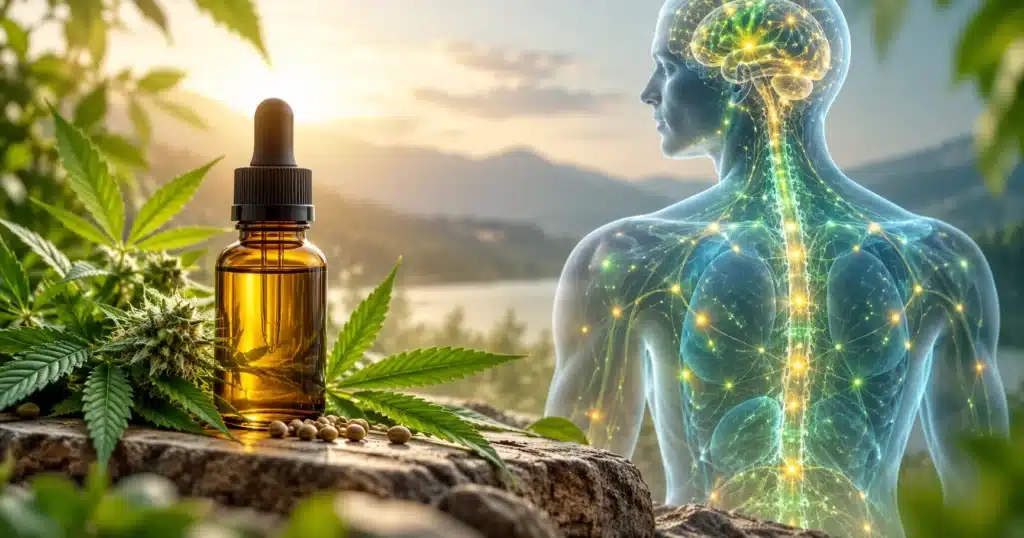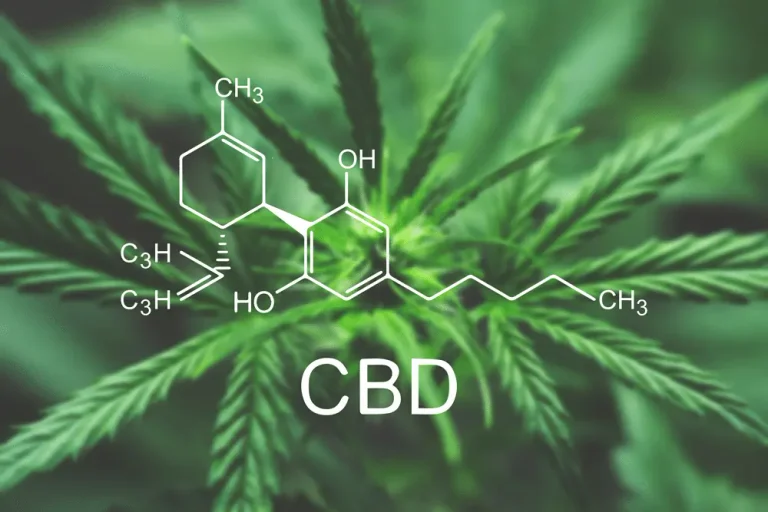
At Growing In Health Florida in Naples, we often hear questions about how CBD and the endocannabinoid system (ECS) are connected, so we put together this plain-language guide. If you have ever wondered what the ECS is, how it relates to sleep, appetite, and stress, or where CBD fits into the picture, you are in the right place. Below, we explain the system in three simple parts, separate what researchers know from what they are still studying, and share practical tips for choosing a quality product. We keep the science honest and the language plain, so you can make informed choices with your healthcare professional.
• The endocannabinoid system (ECS) is a signaling network your body makes and uses on its own, whether or not you ever try CBD.
• It has three main parts: endocannabinoids, receptors (called CB1 and CB2), and enzymes that break the signals down.
• CBD is non-intoxicating and is one of several plant cannabinoids researchers are studying, but exactly how it works is still being worked out.
• Product quality matters. Look for a third-party lab report, a listed THC level, and clear serving directions.
• Talk with a healthcare professional before you start, especially if you take medications.
When you see “endo,” think internally. Cannabinoids are compounds that interact with the ECS. Your body makes its own, called endocannabinoids. Plants such as hemp make others, including CBD, CBG, CBN, and THC.
The ECS is thought to help our bodies reach and maintain homeostasis, or balance. It works through receptors, often called CB1 and CB2, found throughout the body. Researchers are studying its role in everyday functions such as stress, appetite, sleep, and cognitive function.
An easy way to picture it is hunger. Your body sends signals from the brain to the rest of the body all day long. When it’s time to eat, you can feel it. If you don’t respond, the signal gets stronger, and you might even feel a little “hangry.” Appetite is one of the functions researchers connect to the ECS, and it is a simple example of the body telling us what it needs.
Harvard Health Publishing describes the ECS as a vast network of chemical signals and cellular receptors. In simple terms, it has three parts. Endocannabinoids are messenger molecules your body makes, and anandamide was the first one discovered. Receptors, mainly CB1 and CB2, receive those messages. Enzymes then break the messengers down once their job is done.
| Part of the ECS | What It Does | Where It Is Found |
| Endocannabinoids (such as anandamide) | Messenger molecules that carry signals | Made by your own body |
| CB1 receptors | Receive signals and help regulate the activity of other messengers | Mostly the brain and spinal cord |
| CB2 receptors | Receive signals linked to immune activity | Mostly immune cells and tissues |
| Enzymes | Break down endocannabinoids after they have done their job | Part of the same signaling network |
| Plant cannabinoids (CBD, THC, CBG) | Compounds that can interact with the system | Made by the hemp or cannabis plant |
The same article lists learning and memory, emotional processing, sleep, temperature control, and pain control among the functions linked to the ECS. It also describes the field as being at the dawn of an age of discovery. That is why we avoid big promises and stick to what is known.
Sleep is also closely tied to how the body keeps its balance. Researchers are studying how the ECS may relate to sleep, including REM (rapid eye movement) sleep, the stage linked to dreaming, memory, and emotional processing. Good sleep habits matter no matter what products you choose.
Many researchers describe the ECS as working in the background all day to help keep the body in balance. Scientists are still learning how it relates to inflammation, discomfort, and stress, and there is a lot more to learn.
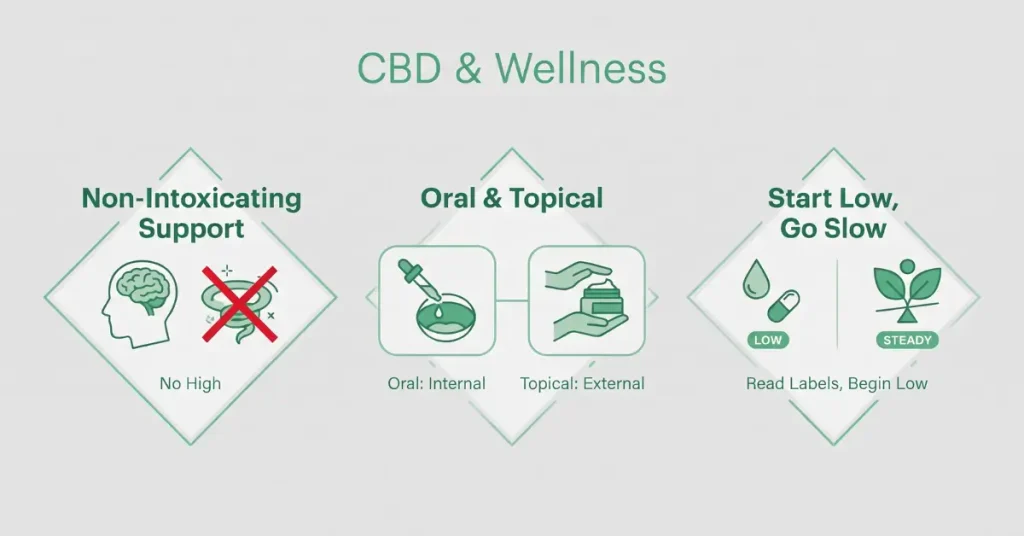
CBD, or cannabidiol, is one of the best-known cannabinoids from hemp. Researchers are still working out exactly how CBD interacts with the ECS, so the science is ongoing. What we can say is that CBD is non-intoxicating, so it does not create a high. Many adults explore it as one part of a broader wellness routine alongside sleep, nutrition, movement, and stress management.
THC and CBD are both cannabinoids, but they behave differently. Harvard Health notes that stimulating CB1 receptors is what causes the high associated with cannabis. CBD does not create that high, but some product types contain trace THC, so reading the label still matters.
CBD comes in different forms. Some people prefer topical products applied to a specific area, while others prefer to take CBD orally. Everyone responds differently, so start low, go slow, and read labels carefully. At Growing In Health Florida, our team is happy to walk you through the options in person.
It is also worth knowing what the research does and does not show. The National Center for Complementary and Integrative Health notes that CBD has been linked to interactions with other drugs and that over-the-counter CBD products can contain more or less CBD than the label states. The FDA has approved a prescription medication containing purified CBD for certain rare forms of epilepsy. That is different from the CBD products you find in a store, so talk with your healthcare professional before trying CBD, especially if you take medications.
The FDA also says products that have not gone through its drug approval process have not been evaluated as to whether they work or what the proper dosage may be. In plain terms, no one can promise you a result, which is why we focus on education and lab-tested products.
CBG, or cannabigerol, is often called the mother of cannabinoids because other cannabinoids develop from its acid form, CBGA, as the plant grows. You will see more CBG in product ingredient lists as interest in it grows. Research on CBG is still early, so we encourage you to ask questions and read labels.
The three product types differ in what they contain:
Full spectrum includes CBD plus other cannabinoids and terpenes, along with trace amounts of THC. Some people choose it because of the entourage effect, the idea that cannabis compounds may work better together than alone. Researchers continue to study that theory. If you are drug tested, trace THC may matter, so ask us before you buy.
The broad spectrum includes other cannabinoids and terpenes but no THC.
Isolate is CBD alone, with no other cannabinoids or terpenes.
Rules for products that contain THC are changing, so ask our team what is currently available. For a closer comparison, read our guide to full spectrum vs. broad spectrum vs. isolate CBD. If you are curious about related compounds, see what THCA is and how it differs from THC.
Quality varies from one product to the next, so a few quick checks go a long way. Before you buy, look for:
• A third-party lab report (Certificate of Analysis) that confirms the CBD and THC levels
• A batch or lot number on the package that matches the lab report
• A clear ingredient list and serving size
• A product type you understand: full spectrum, broad spectrum, or isolate
• No promises to treat, cure, or prevent any disease
If a product is missing any of these, ask questions or choose another one. Our team is glad to help you read a label before you buy.
Myth: only people who use cannabis have an ECS. Everyone does. Your body makes its own endocannabinoids, and the system is part of normal human biology.
Myth: CBD and THC do the same thing. Both are cannabinoids, but THC is the one linked to the high. CBD is non-intoxicating.
Myth: more CBD is always better. There is no proven best amount, which is why the common advice is to start low and go slow.
Myth: CBD replaces healthy habits. Sleep, nutrition, movement, and stress management come first. CBD, if you choose it, is one small part of a routine.
If you decide to try CBD, keep it simple. Begin with the smallest serving on the label, make one change at a time, and give it a few days before you adjust. Keep short notes on what you took, when you took it, and how you felt. Avoid adding several new products at once, because it becomes hard to tell what is helping or not. Check in with your doctor or pharmacist if anything changes.
Whether you shop with us or anywhere else, these questions help you buy with confidence:
• Can I see the third-party lab report for this batch?
• How much THC does it contain, if any?
• Is it full spectrum, broad spectrum, or isolated?
• What is the serving size, and how should I start?
• Could it interact with my medications?
A good shop will welcome these questions. At Growing In Health Florida, we are happy to answer every one of them.
It is a network of receptors and naturally made compounds that is thought to help the body maintain balance, known as homeostasis. Researchers are studying its role in functions such as appetite, sleep, stress, and cognition. Cannabinoids from plants such as hemp can interact with this system.
Yes. The endocannabinoid system is part of normal human biology, and your body makes its own endocannabinoids whether or not you ever use a hemp product. Researchers are still learning how it works, so it is best seen as an active area of study, not a quick fix.
No. CBD is non-intoxicating, so it does not create a high. Full spectrum products contain trace amounts of THC, so check the label and lab results, especially if you are drug tested. Ask our team to show you the third-party lab report for any product you are considering.
Researchers are studying how the endocannabinoid system relates to sleep, including REM sleep, the stage linked to dreaming and memory. The science is still developing, so it is not a promise of better rest. Good sleep habits matter most, so talk with a healthcare professional about ongoing sleep concerns.
The full spectrum contains CBD, other cannabinoids, terpenes, and trace THC. The broad spectrum contains other cannabinoids and terpenes but no THC, and the isolate is CBD alone. Ask our team which options are currently available. Broad spectrum and isolation may suit people who want to avoid THC.
CBG, or cannabigerol, is another cannabinoid made by the hemp plant. It is often called the mother of cannabinoids because others develop from its acid form, CBGA. Like CBD, it is non-intoxicating, and research on CBG is still early, so ask questions and read labels carefully.
Yes, especially if you take medications or have a health condition. CBD has been linked to interactions with some drugs, so a healthcare professional can help you decide whether it fits your routine. Bring a list of your medications to that conversation.
For more information, message me at info@growinginhealthflorida.org, come by the store, or give me a call at (239) 331-4807. We are at 7211 Vanderbilt Beach Rd #3, Naples, FL 34119, and open Monday through Saturday from 10 a.m. to 8 p.m. and Sunday from 12 p.m. to 5 p.m.
You can also explore our CBD education classes or contact us. Growing In Health Florida is here to help. I’m always happy to answer your questions, and I encourage you to include your healthcare professional in any decision about your health.