
Learning how to read a CBD label is the quickest way to separate a quality hemp-derived product from a vague one. A good CBD product label shows the exact type, the milligrams of CBD per serving, a complete ingredient list, a batch number, and a link to third-party lab results. At Growing in Health Florida in Naples, I walk customers through these details every week, and it takes about two minutes once you know where to look. This guide explains each part of the label in plain language, from cannabinoid profile to QR code, so you can compare hemp products with confidence and skip the guesswork.
To read a CBD label, check five things in order: extract type, CBD per serving, ingredients, batch number, and the matching lab report.
Once you have done this a few times, a CBD product label stops feeling like a puzzle. This guide to reading labels covers each step in detail, and our CBD education resources go deeper on any topic you want to explore.
The spectrum type tells you which hemp compounds are in the product: full spectrum keeps a wide range including trace THC, broad spectrum removes THC, and isolate contains only CBD.
| Type of CBD | THC content | Other hemp compounds | May suit shoppers who |
| Full spectrum | Trace amounts within the legal hemp limit | Cannabinoids and terpenes are generally retained | Want the broadest hemp profile |
| Broad spectrum | Removed or non-detectable (check the lab report) | Some cannabinoids and terpenes retained | Want to avoid THC but keep other compounds |
| CBD isolate | None | None, CBD only | Want purified CBD alone |
Our full breakdown of full-spectrum, broad-spectrum, and isolated CBD explains how each one is made.
Full-spectrum CBD contains CBD plus other naturally occurring hemp compounds, including terpenes and a trace amount of THC that stays within the legal hemp limit. Some people associate this combination with the entourage effect, although research on how cannabinoids interact is still developing.
Broad-spectrum CBD is processed to remove THC while keeping other hemp compounds. Shoppers who want to avoid THC often start here, and the lab report is where you confirm that THC is absent or non-detectable.
CBD isolate is a purified form of CBD with other plant compounds removed, which is why it is often described as the cleanest option. Isolate usually shows a single cannabinoid on the lab report, which makes it the simplest profile to read.
Read two numbers: the total mg of CBD in the whole package and the mg of CBD in a single serving. The per-serving number is what you actually take.
For example, a 30 mL bottle labeled 1,000 mg holds about 33 mg of CBD in each milliliter. A bigger number on the front of the bottle does not automatically mean a stronger serving. Compare the CBD concentration, the serving size, and the number of servings per container before you decide.
No, 20 mg is a common serving size on many CBD products, so it is not unusually high. There is no standard recommended serving for hemp-derived CBD, and the right amount depends on the person and the product.
There is no set number, because response depends on body weight, product format, metabolism, and personal sensitivity, and some people notice nothing at all. Effects at 50 mg vary from person to person and are never guaranteed. Many first-time users begin with the smallest serving listed on the label and check with a healthcare professional before increasing.
The ingredient list tells you what else is in the bottle or package besides CBD, and it should name every component clearly, including the extract, carrier oil, sweeteners, and flavorings.
A CBD oil or tincture typically lists a carrier oil such as MCT oil, hemp seed oil, or olive oil. CBD gummies add sweeteners, flavorings, and pectin or gelatin. Topicals list botanical oils, fragrances, and other skin-care ingredients.
Pay special attention to the difference between hemp seed oil and CBD extract. Hemp seed oil comes from the seeds and is a common carrier oil, but it does not by itself provide a meaningful amount of CBD. If a label lists only “hemp seed oil” with no CBD milligram amount, ask questions before you buy.
Also scan for allergens such as tree nuts, soy, or gluten, and for any ingredient you personally want to avoid. A reputable CBD company will make this easy to find on the package.
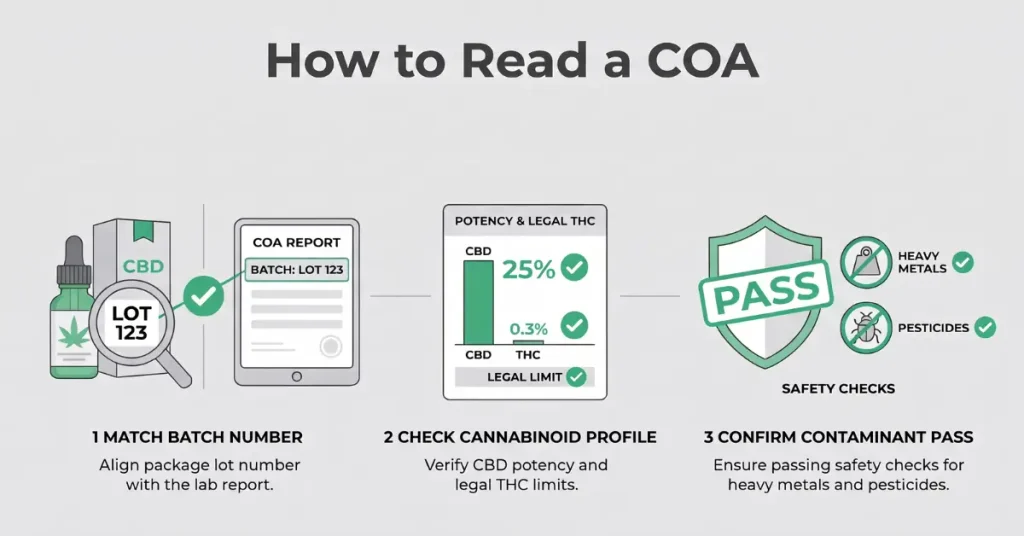
A Certificate of Analysis is a third-party lab report for a specific batch, and you read it by matching the batch number and checking the cannabinoid results against the label.
Most quality CBD products include a QR code on the package that opens the COA. Reputable manufacturers use an independent lab for this third-party lab testing, and the report should be easy to open without creating an account.
The batch number or lot number on your package should be identical to the one printed on the lab report. If the numbers differ, the report may describe a different production run, and it cannot confirm what is in your product.
To read the cannabinoid profile, find the CBD result and compare it with the milligrams promised on the label, then check the THC content.
A full-spectrum product should show only trace THC within the legal hemp limit, and a broad-spectrum product should show THC as removed or non-detectable. Many reports also list other cannabinoids and terpenes.
A thorough lab report also screens for contaminants such as heavy metals, pesticides, residual solvents, and microbial growth. Passing results here matter as much as the CBD number, because they speak to product safety rather than potency.
High-quality CBD comes with clear labeling: a stated extract type, mg per serving, full ingredients, a batch number, and a current third-party lab report that matches the product.
Other signs include transparent hemp sourcing, a company that answers questions openly, and realistic wording instead of dramatic promises.
Rather than avoiding a single name, avoid any CBD brand that shows these warning signs on its label or website:
Yes, CBD isolate is the closest option, and a lab report is how you verify purity. Even then, “100% pure” is a marketing phrase, so look for the purity percentage on the Certificate of Analysis instead of trusting the claim alone.
The date on a CBD label is usually a best-by or expiration date, and some labels also show the manufacture date. It tells you how long the maker expects the product to stay at its best.
Heat, light, and air can degrade cannabinoids over time, so store CBD in a cool, dark place with the cap tightly closed. A lab report dated close to the production run is a good sign that the testing reflects the batch you are holding.
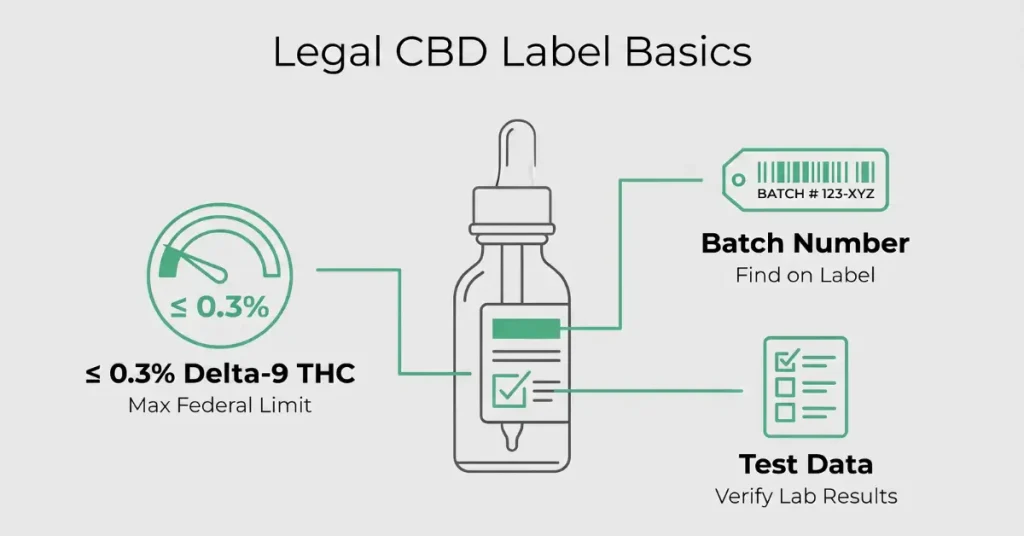
Hemp-derived CBD oil is federally legal when the product contains no more than 0.3 percent delta-9 THC on a dry weight basis, although the FDA still regulates how CBD products may be marketed.
The FDA has also said that CBD cannot be legally added to food or sold as a dietary supplement, and that it has approved only one prescription CBD drug. You can read the agency’s explanation in its questions and answers on cannabis and CBD regulation. Label requirements for CBD can also vary by state and product type, so ask the retailer how the product complies. Whether you are reading a CBD label or a broader cannabis label, the habit is the same: look for the batch number and the test data.
CBD is not risk-free, and side effects can include drowsiness, digestive upset, and changes in appetite, so it is best to start with the smallest serving and talk with a healthcare professional.
CBD side effects in elderly adults deserve extra care. Older adults often take several medications, and the FDA notes that CBD can affect how the body processes certain drugs. A doctor or pharmacist can help you decide whether CBD fits your situation. This is true for anyone who is pregnant, nursing, or managing a medical condition as well.
Be cautious of any label or salesperson that promises results. Responsible retailers talk openly about what is known and where research is still developing.
On hemp CBD products, indica and sativa words are mostly marketing, and the cannabinoid and terpene data on the lab report tell you far more about what is inside.
If you see strain names, ask the retailer what they mean for that specific product. You will learn more from the terpene section of the Certificate of Analysis than from the name on the front.
A local shop lets you hold the product, read the label, and ask questions in person, which makes the whole process faster and less confusing.
At Growing in Health Florida, I am happy to open the lab report with you and explain each line. You can browse our CBD selection online or visit us at 7211 Vanderbilt Beach Road, Suite 3, Naples, FL 34119, or call (239) 331-4807.
Knowing how to read a CBD label turns a crowded package into useful information. Check the exact type, compare mg per serving, read every ingredient, match the batch number to a current Certificate of Analysis, and be wary of big promises. Those steps work for any hemp-derived product, from oils to gummies. If a label leaves you unsure, stop by Growing in Health Florida in Naples, and I will walk through it with you in person.
Supporting your wellness journey, naturally,
Hans Doherty, Proprietor
The most important thing is the batch number and its matching lab report, because they confirm the product was independently tested. After that, check the CBD per serving and the ingredient list.
Start with the extract type, then find the mg of CBD per serving, then read the ingredients and scan the QR code for the lab report. Our five-step checklist near the top of this guide walks you through it.
There is no fixed answer, because drop size varies by bottle and effects vary by person and product. Use the mg per mL on the label rather than counting drops, and follow the serving directions on the package.
No single brand is best for everyone. Judge quality by criteria instead: independent lab results that match the batch, clear ingredients, transparent sourcing, and honest marketing.
The two cannot be compared directly, and neither should be treated as harmless. The FDA has noted that CBD can cause liver injury in some situations, and alcohol is well known to affect the liver, so speak with a doctor if liver health is a concern.
On hemp CBD products, the label may not say, and the terms are often marketing language. The lab report’s cannabinoid and terpene data are a more reliable guide to what you are buying.
That question applies to THC-rich cannabis, which is outside the scope of this guide. Hemp-derived CBD products are not designed to produce a high, so choose them based on lab data instead of the indica or sativa label.
That depends on THC-dominant products, which this guide does not cover. For hemp CBD, we do not recommend choosing by strain nickname, and the lab report is the better tool.
Experiences vary, and some people report feeling calm or relaxed while others notice little. CBD is not approved to treat conditions other than the one prescription use the FDA has cleared, so talk with a healthcare professional about your goals.
It is usually a best-by or expiration date, and some labels also list when the batch was made. Store the product in a cool, dark place to keep it at its best.
Hemp-derived CBD oil is federally legal when it contains no more than 0.3 percent delta-9 THC on a dry weight basis. The FDA still regulates marketing claims, and state rules can differ, so ask the retailer about the specific product.