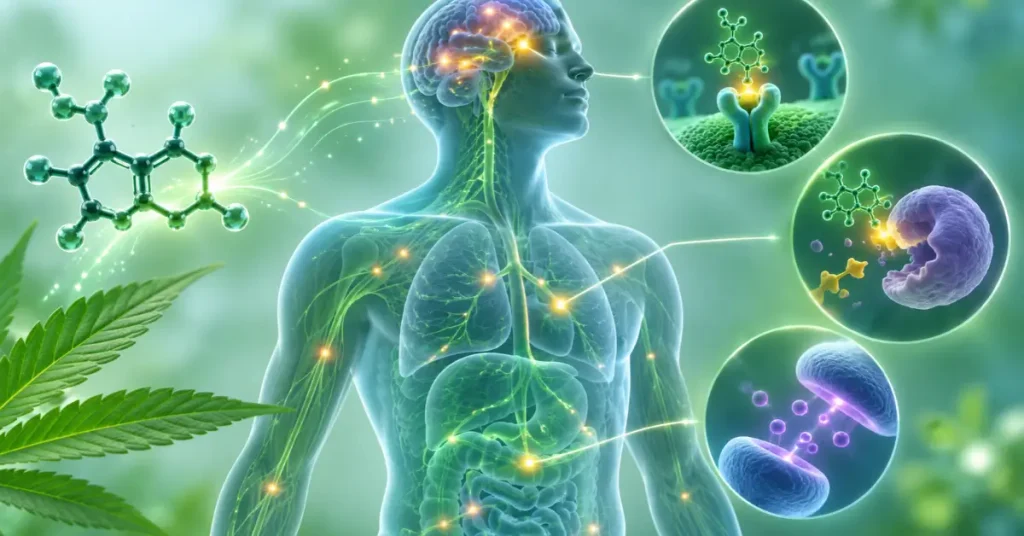
CBD works indirectly. It does not switch on the same receptor as THC. Instead, it slows the enzyme that breaks down anandamide, one of your body’s own cannabinoids, and it acts on serotonin and pain-related receptors. Most of the evidence comes from lab and animal studies, and no CBD product is FDA-approved for general wellness.
This guide is written for readers in North Naples, Naples Park, Pelican Bay and nearby neighborhoods who want the science in plain words. Talk with your healthcare provider before you try any hemp product.
CBD is a hemp compound that does not cause a high. THC, the compound in marijuana, does, because it binds tightly to the CB1 receptor in the brain. CBD barely binds to that receptor, so it behaves very differently.
CBD’s actions fall into three groups: it changes how your own cannabinoids are broken down, it changes how the CB1 receptor responds, and it acts on targets outside the cannabinoid system. The sections below cover each one.
The endocannabinoid system (ECS) is the signaling network that CBD touches first. It includes cannabinoids your body makes, receptors such as CB1 and CB2, and enzymes that clean up after the signals. For a full breakdown of those three parts, read our guide to CBD and the endocannabinoid system. This page focuses on what CBD itself does once it is in the picture.
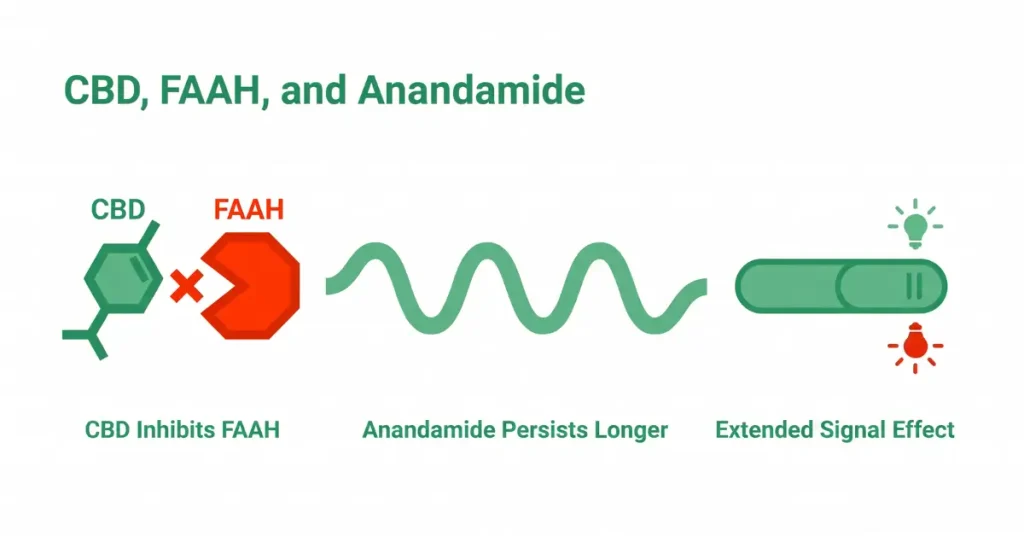
CBD slows FAAH, so anandamide stays active longer. Think of a dimmer switch, not a key. Reviews of the research describe this FAAH inhibition as one proposed indirect action, and it has been reported mainly in lab studies (PMC review of CBD pharmacology).
The practical point is that CBD does not add a new signal. It may let a signal your body already makes last a little longer. Researchers still call the full picture unsettled, so no one can promise a result.
CBD does not lock into CB1 the way THC does. Lab studies suggest it acts as a negative allosteric modulator, which means it changes how the receptor responds to other signals without pressing the main switch itself (McPartland et al., British Journal of Pharmacology).
Here is the plain version. THC pushes the CB1 receptor like a key in a lock. CBD turns the lock’s volume down. That difference helps explain why the two compounds feel so different.
CBD also acts on targets outside the ECS. One review counted more than 65 molecular targets, with the 5-HT1A serotonin receptor and the TRPV1 channel among the most studied (PMC review).
| Target | What CBD appears to do | What was studied | Level of evidence |
| 5-HT1A (serotonin) | Activates it | Anxiety-related responses | Mostly animal |
| TRPV1 | Activates it, then desensitizes it | Pain signaling | Mostly lab and animal |
| FAAH | Slows it | Anandamide levels | Mostly lab |
| CB1 | Modulates how it responds | Effects of THC and 2-AG | Mostly lab |
We list the evidence level next to each finding so you can judge the claims yourself.
The entourage effect is a theory that CBD and other hemp compounds work better together. It has not been proven in people. Full-spectrum and broad-spectrum products keep other hemp compounds, while isolate does not. Our guide to the entourage effect explains the theory and its limits. Choose between product types mostly by THC level, taste and testing, not by promises of stronger results.
Human evidence is limited. The FDA has approved one CBD medicine, Epidiolex, for severe, treatment-resistant epilepsy syndromes. It has not approved CBD for other medical uses, so every other benefit claim should be treated as unproven.
Cell and animal results often do not carry over to people. Treat every mechanism above as an explanation of how CBD may work, not a promise of what it will do for you.
The format changes how much CBD reaches your blood, not the mechanism. A systematic review of human studies found that smoked CBD was the only route with a measured absolute bioavailability, at 31%, and that peak levels appeared anywhere from 0 to 4 hours depending on the route (Millar et al., Frontiers in Pharmacology). The same review reported higher peak levels after a meal. It also called the human data thin.
For timing and detection windows, see our guide on how long CBD stays in your system.
Dose, format, food and product quality all change how much CBD reaches your blood, and people differ widely. Product purity can also vary by source. Check the certificate of analysis (COA) for every batch. Florida hemp extract labels carry a scannable code that links to it, and our guide to reading a CBD label walks through the steps.
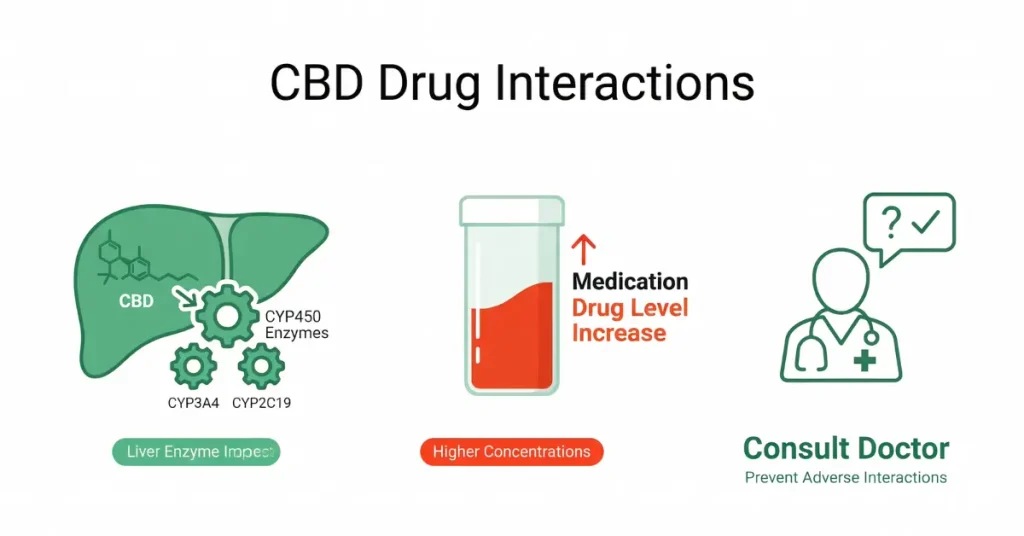
CBD is well tolerated in most studies, but it can interact with some drugs. It affects liver enzymes called cytochrome P450, including CYP3A4 and CYP2C19. The FDA lists liver injury, drowsiness, mood changes and drug interactions among CBD’s risks.
The Epidiolex prescribing information, which covers a prescription drug at medical doses, reports that levels of clobazam’s active metabolite rose about threefold when CBD was added. It also reports that liver enzyme elevations were more common with valproate. Hemp products may differ, but the same caution applies. Hemp products are not monitored with liver blood tests the way Epidiolex patients are, so tell your doctor if you use one. Our guide to safe CBD use covers the basics.
Ask whether CBD could interact with your medications, affect your liver, or be unsafe if you are pregnant, nursing or managing a health condition. Bring this list:
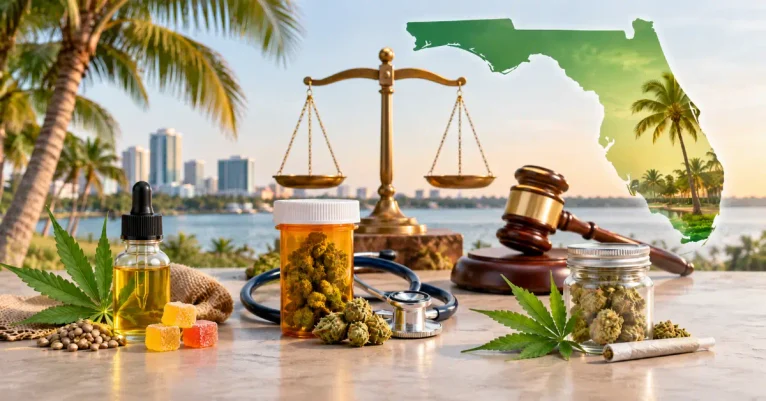
Hemp CBD is legal in Florida within strict limits. Florida defines hemp as 0.3 percent THC or less, and ingestible hemp extract can only be sold to adults 21 and older. Federal rules are changing. A law signed November 12, 2025 redefines hemp using total THC and caps finished products at 0.4 mg of total THC per container. Congress delayed the start of most of those changes to December 11, 2026 (Congressional Research Service). Full-spectrum products carry the most risk under the new cap.
Choose a product with a batch COA, clear CBD and THC amounts per serving, and a format that fits your routine. Florida Statute 581.217 requires a lab COA and a scannable code on hemp extract labels (Florida Statutes, section 581.217). Our guide to lab-tested CBD and how to read a COA explains what Florida law requires for hemp extract and how to check any product.
Our team at Growing In Health Florida, at 7211 Vanderbilt Beach Rd, Suite 3, Naples, FL 34119, can help you read a COA in person. We are open Monday to Saturday 10 AM to 8 PM and Sunday 12 PM to 5 PM.
CBD binds only weakly to CB1. Lab studies suggest it can change how the receptor responds to other signals. THC, by contrast, binds tightly to CB1 in the brain, which explains the high. Scientists are still studying how CBD’s modulation plays out in people.
CBD interacts with drugs that CYP3A4 and CYP2C19 process. Ask your pharmacist or doctor first, do not stop or change any prescription on your own, and tell every provider that you use CBD.
No. Dose, format and product quality change results, and human evidence is limited, so results differ between people. No CBD product is FDA-approved for general wellness, so keep your expectations realistic.
In animal studies, CBD’s effects on pain signaling involved TRPV1 and 5-HT1A receptors. Human proof is limited, and no CBD product is FDA-approved to treat pain. Ongoing or severe pain deserves a medical exam, not self-treatment with a supplement.
Hemp CBD is legal in Florida within strict limits. Federal THC caps are set to start December 11, 2026 for most products, so check current rules before you buy. Buyers of ingestible hemp extract must be 21 or older, and products need a lab COA.
CBD works indirectly. It slows the breakdown of anandamide, changes how CB1 responds, and acts on 5-HT1A and TRPV1. Human evidence keeps growing, and format and quality change results.
Bring your questions, your medication list and any lab report you have, and we will help you read the label. Talk with your doctor before you start CBD. Ready to talk it through? Call (239) 331-4807.