
CBD for pets is a hemp-derived supplement that some owners use to support joint comfort and calm, but it is not an approved treatment, and the best research so far involves dogs with arthritis. As pet owners, we want the very best for our furry companions, especially when they’re dealing with discomfort or stress. More pet lovers in Naples, Florida, are asking about CBD for stiff joints and nervous behavior. From Pelican Bay to Golden Gate, the same questions come up: does it work, is it safe, and what should I buy? At Growing In Health Florida, we hear those questions often. This guide covers what research says, where the evidence is thin, and why your veterinarian comes first.
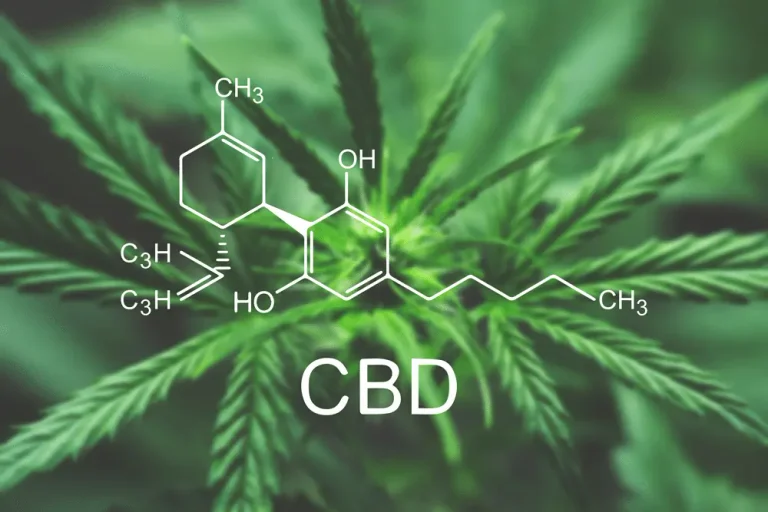
Pet owners are turning to CBD because they want gentle options for aging joints and everyday stress. CBD, or cannabidiol, is a non-psychoactive compound derived from the hemp plant. Unlike THC, CBD won’t get your pet “high.” That does not make it risk-free, and it is not a substitute for veterinary care. Pet-focused products are becoming more widely available, including pet-friendly CBD oils, chews, and topicals. If you want the basics on the compound itself, our cannabinoid glossary explains CBD, THC, and the rest in plain language.
At Growing In Health Florida, we hear from pet owners who want help sorting through the options. Our team selects CBD for pets products with quality in mind, and we can show you lab reports on request. We focus on THC-free formulas, such as broad spectrum or isolate, because pets can be more sensitive to THC than people.
Research on CBD for pets is early. The strongest study involves dogs with osteoarthritis, and far less is known about cats or about anxiety. Pet CBD is also sold as a supplement, so it has not been approved for these uses.
A 2018 placebo-controlled study in dogs was randomized, crossover, and blinded for both owners and veterinarians. Dogs with osteoarthritis received CBD oil at 2 mg/kg every 12 hours for four weeks. Owners and vets reported significantly less pain and more activity. However, blood tests showed a rise in alkaline phosphatase, a liver-related marker, and the study was short. That is a study dose, not a dosing recommendation, so ask your vet before giving your pet anything.
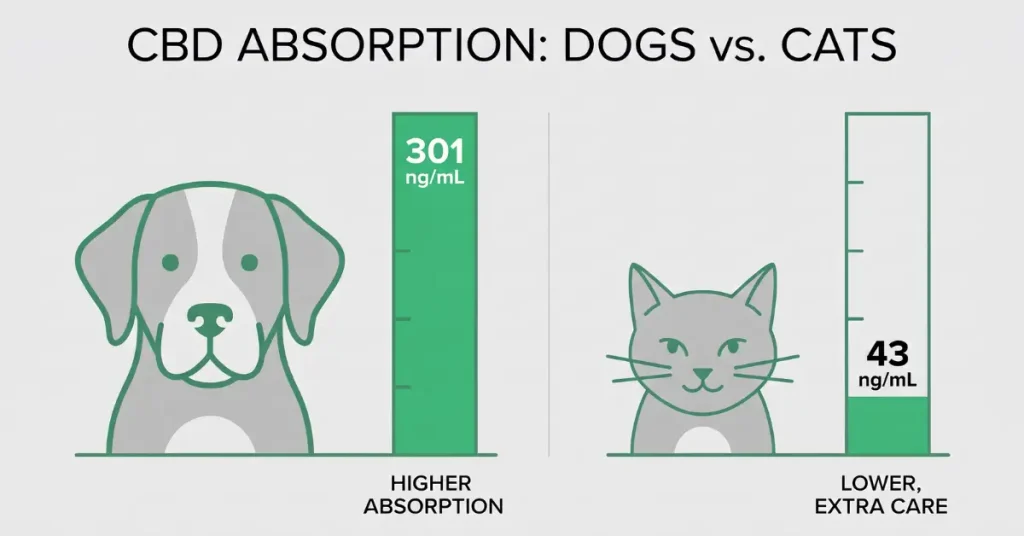
Yes, and that is one reason cat owners should go slower. A 2019 single-dose study in healthy dogs and cats found that cats had much lower CBD levels in their blood than dogs (a peak of about 43 ng/mL in cats versus 301 ng/mL in dogs), which suggests cats absorb or clear CBD differently. The cats also showed excessive licking and head-shaking while the oil was given, and one cat had a liver enzyme (ALT) that stayed above the normal range through the trial. Blood work showed no clinically significant changes overall. The study was small and short, so treat it as a reason for extra care with cats, not a settled rule. You can read the study abstract for the details.
CBD is most often used for joint comfort in older dogs, and dog studies are where the best evidence sits. As dogs and cats age, they often develop arthritis and other degenerative joint diseases. These conditions can lead to stiffness, reduced activity, difficulty climbing stairs, and even chronic discomfort.
Some owners tell us their older pets seem more comfortable on walks or moving around the house, though results vary. Many of the signs of joint trouble are easy to miss, such as slowing down, hesitating at stairs, or licking a sore spot. Because pain can have causes that need real treatment, a vet exam should come first. Weight management, gentle exercise, and a supportive bed also matter. Most published research is in dogs, so there is less evidence for cats.
Some owners use CBD for pet anxiety, but controlled research is more limited than for joint comfort, and results vary. Dogs and cats can suffer from separation anxiety, travel-related stress, noise phobias (like thunderstorms or fireworks), and generalized anxiety triggered by changes in their environment or routine.
Pets in busy areas like Naples can face loud noises, crowded places, and long stretches alone while their people are at work or traveling. Southwest Florida’s summer thunderstorms and hurricane season add to the noise. Signs of stress include pacing, whining, barking, destroying household items, or withdrawal. A 2020 study in Frontiers in Veterinary Science tested CBD-containing treats on dogs’ response to a noise-induced fear test, and more research is needed. Training, exercise, and a quiet space often matter as much. For dog owners, our guide on CBD and CBN for dog anxiety covers what a calming routine can look like.
Many customers at Growing In Health Florida ask about CBD-infused treats or tinctures. Drowsiness is a commonly reported side effect, so do not expect CBD to be non-sedating, and talk with your vet about any pet with severe anxiety.
Owners sometimes ask about CBD for seizures, appetite, or digestive upset, and these are medical issues first. Seizures are an active area of animal research, but CBD is not a cure, and you should never change or stop a prescribed seizure medication without talking to your veterinarian. A pet that stops eating, or has ongoing digestive trouble, needs a vet exam, not a supplement.
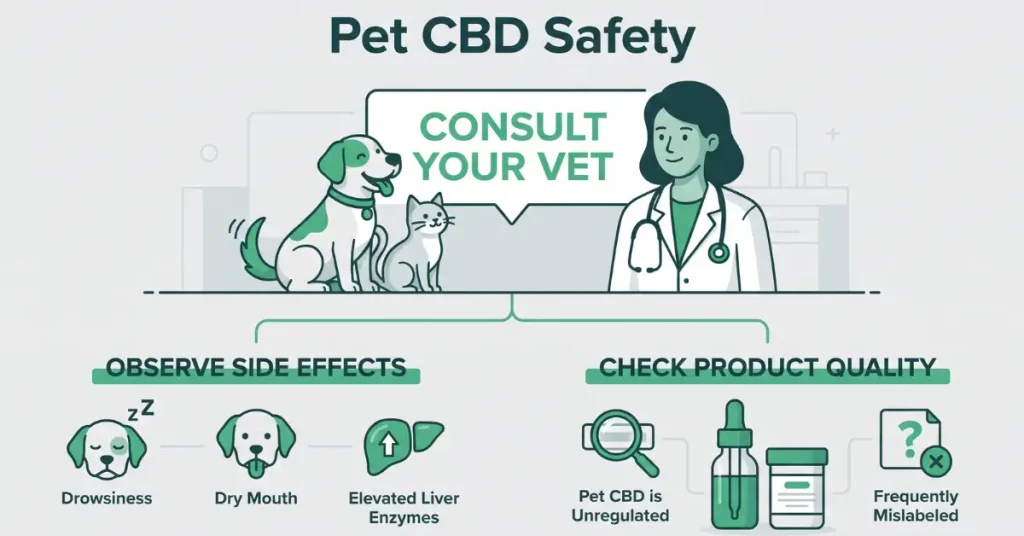
CBD may be safe for many pets, but it is not risk-free, and you should talk with your vet first. Possible side effects include drowsiness and dry mouth, and the 2018 dog study saw a rise in alkaline phosphatase. Pets on other medications or with liver, kidney, or other health issues need extra care.
Quality is another concern. Humane World for Animals notes that pet CBD products are sold as supplements that are “not approved or regulated by a federal agency,” and it cites a study finding that more than half of CBD products were labeled incorrectly, with most containing more CBD than listed. It also warns that using CBD for pain “can mask an underlying problem or illness.” Read the full Humane World for Animals guide for more. Always tell your vet if you give your pet CBD.
Look for an animal-specific, THC-free product with a third-party lab report and clear dosing directions. Not all CBD products are created equal. When shopping for your pet, it’s important to choose options specifically formulated for animal use. Here are a few key features to look for:
Choose products with a recent lab report that confirms CBD content and checks for contaminants. Always ensure the product has been independently tested for purity and potency. Given the mislabeling problem above, this matters.
Choose THC-free products. Pets are more sensitive to THC than humans, so opt for broad-spectrum or THC-free formulas. Full spectrum products contain trace THC, so we steer pet owners toward broad spectrum or isolate.
Pick simple ingredient lists. Avoid artificial additives, preservatives, and sweeteners. Choose natural, organic products whenever possible. Some sweeteners can be harmful to pets, so check every label. Our guide on how to read a CBD label walks through what to look for.
Dosing should come from your vet, based on your pet’s weight and condition. It’s always best to start low and adjust as needed. Keep a short log of appetite, energy, and sleep, and stop and call your vet if anything seems off.
The table below summarizes what is known, what is not, and what to do next.
| Topic | What We Know | What to Do |
|---|---|---|
| Joint comfort (dogs) | One 2018 placebo-controlled study found less pain and more activity | Ask your vet; keep other joint care in place |
| Joint comfort (cats) | Most research is in dogs | Ask your vet before trying |
| Dogs vs. cats | A small 2019 study found lower CBD blood levels and more side effects in cats | Go slower with cats; watch closely |
| Anxiety | Controlled research is limited; results vary | Pair with training and a calm space; ask your vet |
| Seizures | Active research area; not a cure | Never change prescribed medication without your vet |
| Side effects | Drowsiness and dry mouth are reported; a liver-related marker rose in the 2018 study | Start low; watch your pet; vet check-ins |
| THC | Pets can be more sensitive than people | Choose THC-free broad spectrum or isolate |
| Quality | Sold as supplements; some are mislabeled | Look for a third-party lab report |
CBD for pets may be worth discussing if your pet has joint stiffness, anxiety, or age-related discomfort, but your vet should decide. However, it’s important to consult with your veterinarian before starting any new supplement, especially if your pet is on other medications or has underlying health issues.
Do not use CBD in place of a diagnosis. If your pet is limping, panting, hiding, or suddenly acting differently, schedule an exam. Many pets are fine with CBD, but some become drowsy or lose their appetite, and professional guidance helps you introduce it safely.
Pet owners in Naples can find CBD products and guidance at Growing In Health Florida, 7211 Vanderbilt Beach Road, Suite 3. At Growing In Health Florida, we are committed to holistic health, whether you’re shopping for yourself or your four-legged companion. Browse our CBD wellness products or ask the team about pet oils, chews, and topicals. We stay informed on new research and can show you lab reports, but we cannot replace your vet’s advice.
CBD may be safe for many pets, but it is not risk-free. Drowsiness and dry mouth are reported, and a 2018 dog study saw a liver-related blood marker rise. Pets on medications or with health conditions need extra care, so talk with your vet first.
A 2018 placebo-controlled study found dogs with osteoarthritis had less pain and more activity on CBD oil. It was short and showed a liver-related marker rise. CBD is not a cure, so see your vet about a full arthritis plan.
Some owners say CBD helps their dogs feel calmer, but controlled research is more limited than for joint comfort, and results vary. Training, exercise, a quiet space, and your vet’s advice matter just as much, especially for severe or sudden anxiety.
Most published research is in dogs, so evidence for cats is thinner. A small 2019 study found cats had lower CBD blood levels than dogs and showed licking and head-shaking when given the oil. Talk with your vet before giving CBD, choose a THC-free product made for animals, and watch closely for appetite or energy changes.
Dosing depends on your pet’s weight, health, and the product, so your vet should guide it. Start low, follow the label, and increase only on your vet’s advice. Keep notes on appetite, energy, and sleep, and stop if anything seems off.
CBD itself does not cause a high, but products can contain trace THC, which pets handle worse than people. Choose THC-free broad spectrum or isolate with a third-party lab report. If your pet seems wobbly or very sleepy, call your vet right away.
In most cases, no. Vets generally cannot prescribe or dispense cannabis products, and some states restrict what they can discuss with you about it. They can still help you weigh the decision and watch for side effects.
Yes, always. Your vet can help you choose a product, set a starting amount, and watch for changes in your pet’s health.
Visit Growing In Health Florida at 7211 Vanderbilt Beach Rd #3, Naples, FL 34119. We are open Monday through Saturday from 10 a.m. to 8 p.m. and Sunday from noon to 5 p.m. Ask the team about pet products and lab reports.
CBD for pets may support joint comfort and calm for some dogs, but it is not a cure, and your vet should guide every decision. Choose THC-free, lab-tested products and start low. Our team is happy to answer questions and show you lab reports. To learn more, contact us at (239) 331-4807 or visit 7211 Vanderbilt Beach Road, Suite 3, in Naples, open Monday through Saturday, 10 a.m. to 8 p.m., and Sunday, noon to 5 p.m.