Growing in Health Florida is a CBD and hemp boutique on Vanderbilt Beach Road in Naples, FL. This guide covers what is delta-9 THC is and what to check before you buy.
Short answer: No. Delta-9 THC is the component responsible for the high in cannabis, but it is one compound, not the plant. Hemp and marijuana are both Cannabis sativa L., and federal law currently calls the plant hemp at 0.3% delta-9 THC or less by dry weight. Above that line, it is not hemp.
TL;DR
Delta-9 THC is the compound in cannabis that causes the high. Its full name is delta-9-tetrahydrocannabinol, and searches for “what is delta 9” almost always mean this compound. It is the most abundant form of THC in cannabis plants, and the FDA names it as the component responsible for the high people experience from cannabis.
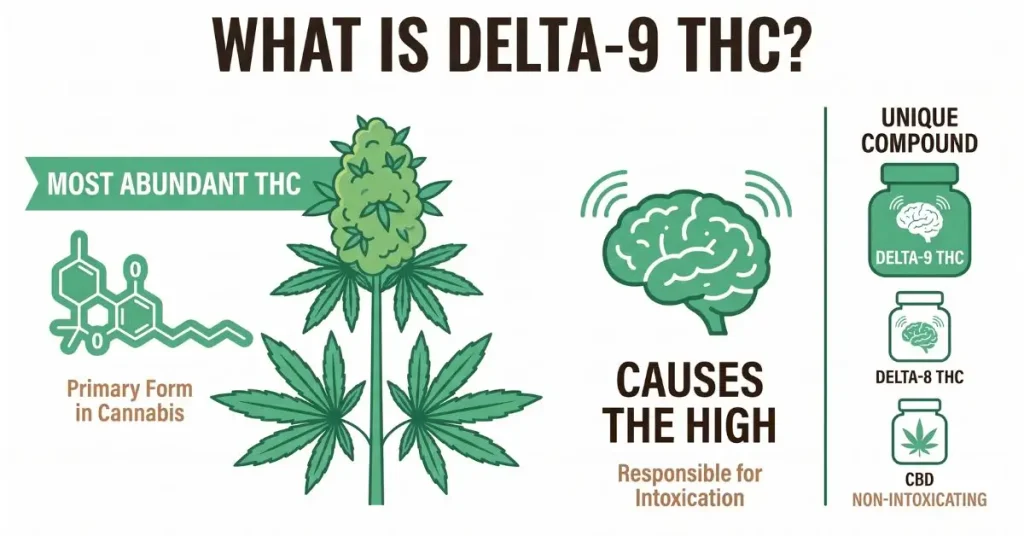
Delta-8 shares delta-9’s chemical formula but is a different compound, compared below. For the non-intoxicating cannabinoid, see our guide to what CBD is.
No. Delta-9 THC is one compound, and marijuana is a plant that contains it. The federal definition of hemp covers the plant Cannabis sativa L. with a delta-9 THC concentration of not more than 0.3% on a dry-weight basis, so the line between hemp and marijuana is a concentration, not a different compound.
Florida Statute 581.217 defines hemp as cannabis with no more than 0.3% total delta-9 THC on a dry-weight basis. For hemp extract, which is a substance intended for ingestion or inhalation, the statute measures 0.3% on a wet-weight basis.
The table compares delta-9 and delta-8. Leafly describes delta-9 as much stronger than both delta-8 and delta-10, while the FDA says delta-8 has intoxicating effects similar to delta-9.
| Delta-9 THC | Delta-8 THC | |
| Potency | Stronger | Weaker |
| In the plant | Most abundant THC form | Not found in significant amounts |
| Chemical formula | C21H30O2 | C21H30O2 |
| Intoxicating? | Yes | Yes |
THC-O acetate is a synthetic product, not naturally occurring delta-9. THCA, or tetrahydrocannabinolic acid, becomes delta-9 THC through decarboxylation, so USDA’s hemp rule counts it in total THC as THC plus 0.877 times the THCA.
Florida treats hemp-derived cannabinoids as legal, not controlled substances, when they comply with Florida Statute 581.217, and it bars sales of hemp extract products to anyone under 21. Marijuana-derived THC is legal only through the state medical program.
Hemp products must meet both applicable state requirements and federal rules. Meeting the hemp THC limit does not automatically make every THC product legal to sell. For example, the FDA says it is a prohibited act to introduce into interstate commerce any food to which THC or CBD has been added, and that hemp status under the Farm Bill does not change that.
Florida has two separate lanes. In the retail lane, the statute says hemp-derived cannabinoids are not controlled substances if they comply with it. Hemp extract may be sold only with a lab report for the batch, and a first violation of the under-21 rule is a second-degree misdemeanor.
In the medical lane, patients must be Florida residents with a qualifying condition and a registry card, and they may purchase medical marijuana only from a state-approved treatment center. A hemp retailer does not dispense it. Growing in Health Florida can arrange a physician evaluation for a medical marijuana card by appointment.
A percentage caps concentration, not dose. The statute caps total delta-9 THC at 0.3% and separately requires the container to list the milligrams of each marketed cannabinoid per serving.
At 0.3%, a 3-gram hemp extract product can hold up to 9 milligrams of total delta-9 THC. Read the per-serving number on the label, not the percentage.
Federal hemp law changes in two stages. Section 781 of Public Law 119-37, enacted November 12, 2025, redefines hemp by total THC, including THCA, and excludes final hemp-derived cannabinoid products with more than 0.4 milligrams combined total per container. That total counts THC, including THCA, plus any other cannabinoids with similar effects, or marketed to have similar effects, as determined by the Department of Health and Human Services. The amendment takes effect 365 days after enactment, which is November 12, 2026.
Congress then narrowed the first stage. Section 2019 of H.R. 6500 (Public Law 119-103) applies Section 781 only to products containing cannabinoids that a cannabis plant cannot naturally produce until December 11, 2026. The Congressional Research Service says the other portions do not take effect until that date. Congress could move the dates again.
The practical effect is this: once the cap applies, a final hemp-derived product whose container holds more than 0.4 milligrams combined of THC and similar-acting cannabinoids no longer meets the federal hemp definition. Florida’s statute uses its own definition, described above.
Call us at (239) 331-4807 to ask which hemp-derived THC products are in stock and how each one fits these rules.
Every hemp extract container sold in Florida must carry a QR code that links to the batch’s lab report, called a certificate of analysis (COA). Florida Statute 581.217 sets the required label items:
Scan the code, then match the batch number on the report to the one on your package. A report for a different batch tells you nothing about your product.
The COA must show four things: the batch was tested by an independent laboratory, total delta-9 THC did not exceed 0.3%, the batch has no contaminants unsafe for human consumption, and the facility that processed it holds a valid permit. The laboratory must be accredited to ISO/IEC 17025.
The container has rules too. It must minimize light exposure, comply with the federal Poison Prevention Packaging Act, and not be “attractive to children,” which the statute defines to include human, cartoon, or animal shapes, branded-candy lookalikes, and color additives.
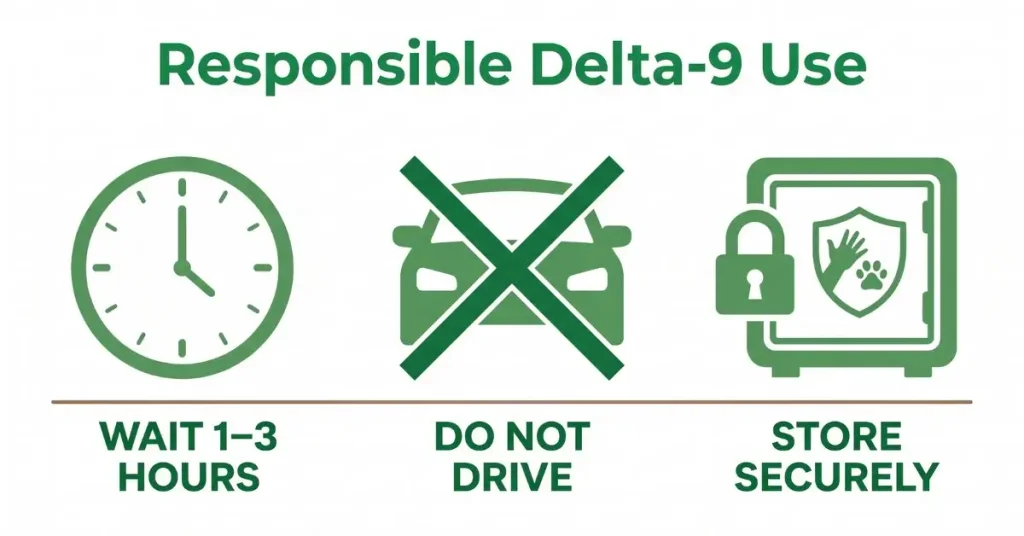
Check the THC amount on the label and start with the lowest appropriate dose. The DEA notes that edibles are processed through the liver, so effects may take one to three hours to appear. Do not take more while you wait.
Read the dose. Use the milligrams per serving printed on the label, as covered above.
Plan for a drug test. In a small four-week McLean Hospital trial, 7 of 14 adults using a full-spectrum hemp extract tested positive for the THC metabolite THC-COOH on a urine screen. The extract held 0.02% delta-9 THC, about 0.8 milligrams a day. It was a CBD extract, not a delta-9 product, and the sample was small, so treat it as a caution, not a prediction. Check your employer’s testing policy first.
Check your medications. The DEA warns that other medications in your system can alter how much THC your body metabolizes. Ask your doctor or pharmacist first.
Do not drive while impaired.
Store it securely. From January 2021 to February 2022, 41% of the poison control exposure cases the FDA reviewed for delta-8 THC products involved patients under 18. Keep every THC product away from children and pets.
Growing in Health Florida is on Vanderbilt Beach Road in Naples. The store carries hemp-derived THC options where legally available, and its website asks shoppers to bring a valid photo ID.
Growing in Health Florida
We serve shoppers from the Vineyards, Pelican Bay, Island Walk, Lely Resort, Naples Park, Heritage Bay, Naples Manor, Golden Gate, Estero, and Bonita Springs.
Before you buy, ask four questions: which products list delta-9 THC, how many milligrams are in each serving, whether the exact batch has a COA, and how much THC and similar-acting cannabinoids the container holds in total compared with the federal 0.4-milligram cap.
Yes. The FDA identifies delta-9 THC as the component responsible for the high. How strongly you feel it depends on the dose, which is why the label lists milligrams per serving. Full-spectrum and broad-spectrum products can intensify that effect further since other cannabinoids may contribute to it.
Yes. THC’s scientific name is delta-9-tetrahydrocannabinol, and most people who say THC mean delta-9. Delta-8 and delta-10 are other forms of THC, with the double bond in a different position. Delta-8 THC is a separate, weaker compound, while delta-9 remains the most abundant and most studied form.
It can. In a small McLean Hospital trial, 7 of 14 participants using a hemp extract with 0.02% delta-9 THC tested positive for the THC metabolite. That trial used a CBD extract, not a delta-9 product, so treat it as a caution, not a guarantee.
No. Florida bars selling hemp extract products to anyone under 21. A first violation is a second-degree misdemeanor. Florida requires ID verification before purchase, and the rule applies specifically to hemp extract meant for ingestion or inhalation, so check the label before buying.
Yes. Federal law is moving to a total THC standard and a 0.4-milligram container cap in stages, with parts starting November 12 and the rest scheduled for December 11, 2026, unless Congress acts again. Growing in Health Florida tracks these changes so our shelves stay compliant as each stage applies.
Growing in Health Florida, at 7211 Vanderbilt Beach Rd #3, carries hemp-derived THC options where legally available. Call (239) 331-4807 for current stock. Bring a valid photo ID when you visit, since the store requires it for every hemp-derived THC purchase and lab report review.
Delta-9 THC is the single compound responsible for cannabis’s high, and the 0.3% line, not a different chemical, is what separates hemp from marijuana under the law. Before you buy, check the milligrams per serving, scan the batch COA, and confirm the THC total against the federal cap phasing in through December 2026. Growing in Health Florida verifies every batch with lab-tested paperwork you can review in person. Visit our Naples store or contact us page at 7211 Vanderbilt Beach Rd #3, or call (239) 331-4807 to ask what’s in stock.