
THCA is a natural compound in raw cannabis that doesn’t cause a typical high, but heat converts it into intoxicating THC.
You see THCA and THC on a cannabis product label. The names look almost identical, but do they work the same way? Not quite. Raw THCA doesn’t cause the usual marijuana high. However, smoking or heating it changes how the compound affects your body.
At Growing in Health Florida in Naples, customers often need clear information about cannabinoids before choosing products. This guide explains what is THCA, how it compares with THC, and what Florida consumers should know about safety and legality.
TL;DR
THCA, or tetrahydrocannabinolic acid, is a natural cannabinoid found in raw cannabis that changes into THC when heated.
The Cannabis sativa plant produces several cannabinoids, including THCA, CBD, CBG, and CBN. Each compound has a different chemical structure.

THCA is the acidic form of Delta-9 THC. It contains an extra chemical part called a carboxyl group.
This structure limits its ability to produce the intoxicating effects associated with THC.
Cannabis plants naturally make THCA as they grow. Fresh marijuana flowers often contain much more THCA than active Delta-9 THC.
Small resin glands called trichomes hold many of the plant’s cannabinoids and terpenes.
Want to understand the other compounds on product labels? Read our guide to CBD, THC, THCA, and other cannabinoids.
THCA doesn’t normally cause intoxication in its raw form, while Delta-9 THC can change mood, memory, perception, and coordination. The main difference comes from their chemical structures.
THC interacts strongly with CB1 receptors in the brain. These receptors form part of the body’s endocannabinoid system. THCA doesn’t interact with these receptors the same way, which helps explain its different effects.
Here’s a simple comparison.
| Feature | THCA | THC |
| Full name | Tetrahydrocannabinolic acid | Tetrahydrocannabinol |
| Natural source | Raw cannabis flowers | Cannabis plants and heated THCA |
| Psychoactive effects | Not typically intoxicating | Causes a high |
| Chemical structure | Contains a carboxyl group | Lacks that extra group |
| Heat exposure | Converts into THC | Can degrade with further heat |
| Potency | Not comparable as a typical intoxicant | Intoxicating potency varies by amount |
| Research | Limited human studies | More extensive research |
| Medical use | No established approved use | Certain THC medicines have approved uses |
| Drug testing | Risk depends on exposure and product content | Can trigger positive results |
| Florida legality | Depends on total THC and compliance | Depends on product classification and laws |
The comparison becomes more useful when you’re reading a product’s certificate of analysis. For example, a cannabis flower might contain very little active THC but a large amount of THCA. Heating can change that result.
Unheated THCA doesn’t produce the typical THC high, but smoking or vaping THCA-rich cannabis can cause strong intoxication. The way someone uses a product makes a major difference. Raw cannabis contains THCA, and heating converts some of that compound into active THC.
Smoking and vaping expose THCA to heat, which converts some of it into Delta-9 THC.
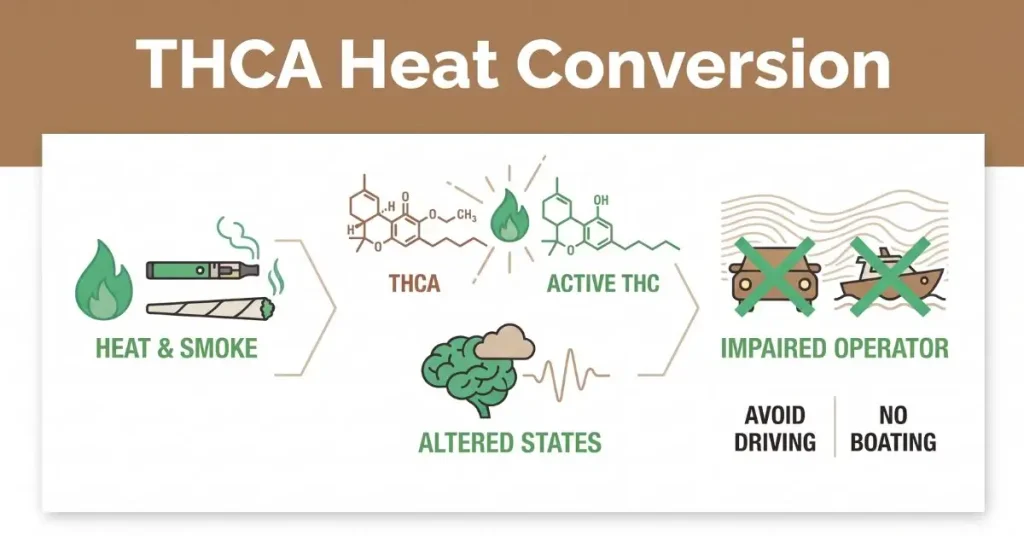
The resulting THC can cause:
The exact effects depend on THC exposure, product strength, and personal sensitivity.
The CDC’s cannabis driving guidance explains how THC can impair judgment, coordination, and reaction time.
For Naples residents, this applies to driving along Vanderbilt Beach Road or boating near the Gulf. Avoid either activity after THC use.
Raw THCA isn’t stronger than THC as an intoxicant. However, a product containing substantial THCA may generate strong THC effects after heating. The final effects depend on how much THC forms and how much enters the body.
Heat changes THCA into Delta-9 THC through decarboxylation, a chemical process that removes the compound’s extra carboxyl group. The name sounds technical, but the idea is simple: before heating, THCA contains an extra chemical group. Heat removes that group, releasing carbon dioxide and forming THC.
Decarboxylation happens when heat or gradual chemical changes remove a carboxyl group.
It can occur during:
Temperature, time, and storage conditions affect how much THCA converts into THC.
The conversion increases a product’s potential intoxicating effects by forming active THC. However, heating doesn’t convert every THCA molecule. Some THC can also degrade during processing. That’s why a laboratory’s estimated total THC doesn’t tell you exactly how much THC someone will absorb.
THCA flower is cannabis flower containing high amounts of THCA, and it may produce effects similar to marijuana when heated. Some sellers describe THCA flower as hemp because its active Delta-9 THC content is low before heating. However, traditional marijuana flowers also contain large amounts of THCA. The main differences often involve product testing, legal classification, and cannabinoid content.
Some laboratories report THCA and Delta-9 THC separately. Others also provide an estimated total THC value. A common calculation is:
The 0.877 factor accounts for the molecular weight lost when THCA changes into THC.
This is an estimate of potential THC content, not an exact measure of THC absorbed during use.
Early research suggests THCA may affect certain biological processes, but scientists haven’t proven medical benefits in humans. Laboratory and animal studies have explored its possible effects on inflammation, nausea, and nerve cells.
Those findings are still early. They don’t establish THCA as a treatment for chronic pain, arthritis, anxiety, or sleep problems. However, understanding how cannabinoids may relate to pain management can provide useful context. Learn more about whether CBD products may help with back pain.
Researchers haven’t established an approved medical use for THCA itself. Certain THC-based prescription medicines have approved uses, but that evidence doesn’t prove THCA products offer the same benefits.
The FDA’s cannabis and CBD safety guidance explains the limits of current research and concerns about unapproved health claims.
Both THCA and CBD are generally non-intoxicating in their ordinary, unheated forms. However, CBD doesn’t naturally convert into Delta-9 THC when heated.
CBD, or cannabidiol, appears in products such as tinctures, gummies, oils, and topical creams. Some full-spectrum CBD products also contain THC.
Always review the complete cannabinoid profile rather than assuming every CBD product is THC-free.
Scientists have limited safety data on raw THCA, while heating it creates THC that can impair memory, judgment, and coordination. The short-term and long-term effects of isolated THCA need more human research. Once heated, products containing THCA can cause THC-related side effects.
No product is automatically safe because its label says THCA or hemp. Possible side effects after THC exposure include:
Older adults should pay particular attention to dizziness and medication interactions. These concerns matter for many customers in Naples retirement communities. People with existing health conditions should seek medical advice before using cannabinoids.
Independent laboratory reports can reveal a product’s cannabinoid content and possible contaminants. A certificate of analysis, or COA, should identify the product batch and report its THC and THCA levels. Look for testing that covers pesticides, heavy metals, mold, and residual solvents. A lab report helps evaluate product quality, but it doesn’t guarantee safe use.
THCA products must meet Florida’s hemp or medical marijuana rules, and low active Delta-9 THC alone doesn’t establish legality. Florida applies statewide hemp laws to Naples, North Naples, Golden Gate, and the rest of Collier County.
The 2018 Farm Bill established federal hemp rules. Florida also regulates hemp cultivation, retail extracts, labeling, and product testing.
Yes. Florida’s hemp definition considers total Delta-9 THC, which accounts for THCA’s potential conversion. Qualifying hemp cannot exceed 0.3% total Delta-9 THC by dry weight. Hemp extracts have a separate wet-weight standard. Florida also imposes testing, labeling, and packaging requirements for retail hemp extracts. You can review the 2026 Florida State Hemp Program, Section 581.217 for these requirements. A package showing only 0.2% active THC may still exceed the legal total THC limit.
A medical marijuana card isn’t required to purchase a compliant retail hemp product. However, medical marijuana follows different rules. Qualified Florida patients need physician certification and state registration. Florida also restricts sales of ingestible and inhalable retail hemp extracts to adults 21 and older.
Check the THCA percentage, total THC content, independent lab report, and Florida legal requirements before choosing a product. Product labels sometimes promote high THCA levels without clearly explaining how heating affects potency.
Use this checklist:
For more practical shopping information, read our first-time CBD shopping guide for Naples residents.
Don’t judge product strength or safety from the front label alone.
Growing In Health Florida offers cannabinoid education, personal guidance, and carefully selected hemp products at its North Naples boutique. Owner and educator Hans Doherty helps customers understand cannabinoids, ingredients, and product differences.
Our location on Vanderbilt Beach Road serves people from Island Walk, Vineyards, Heritage Bay, Golden Gate, and nearby Collier County communities. Growing In Health Florida focuses on education rather than pushing the same product toward every customer.
Our services include:
Learn more about our CBD education classes in Naples, including topics covering the endocannabinoid system and informed product decisions.
No. THCA is the acidic form of THC. It doesn’t produce typical intoxication until enough heat converts it into active THC.
Pure, unheated THCA doesn’t normally cause a high. However, products containing THCA may also contain active THC.
Yes. Heating removes THCA’s carboxyl group through decarboxylation, creating Delta-9 THC.
Legality depends on total THC content and other Florida’s legal requirements. A low active Delta-9 THC number doesn’t establish legal compliance.
Heated THCA products can trigger positive THC results. Products containing active THC may also pose a risk without intentional heating.
Scientists haven’t established that THCA is safer than THC. Heating converts THCA into intoxicating THC, which carries known health risks.
The difference between THCA and THC comes down to chemical structure, heating, and intoxicating effects. If you’re wondering what is THCA, remember that raw THCA doesn’t cause a typical high. Heating can convert it into active THC. Check total THC content, product testing, and Florida regulations before making decisions. Growing In Health Florida helps Naples customers understand these differences through personal education and product guidance. Contact the store directly to confirm current THCA product availability and applicable purchase requirements.